
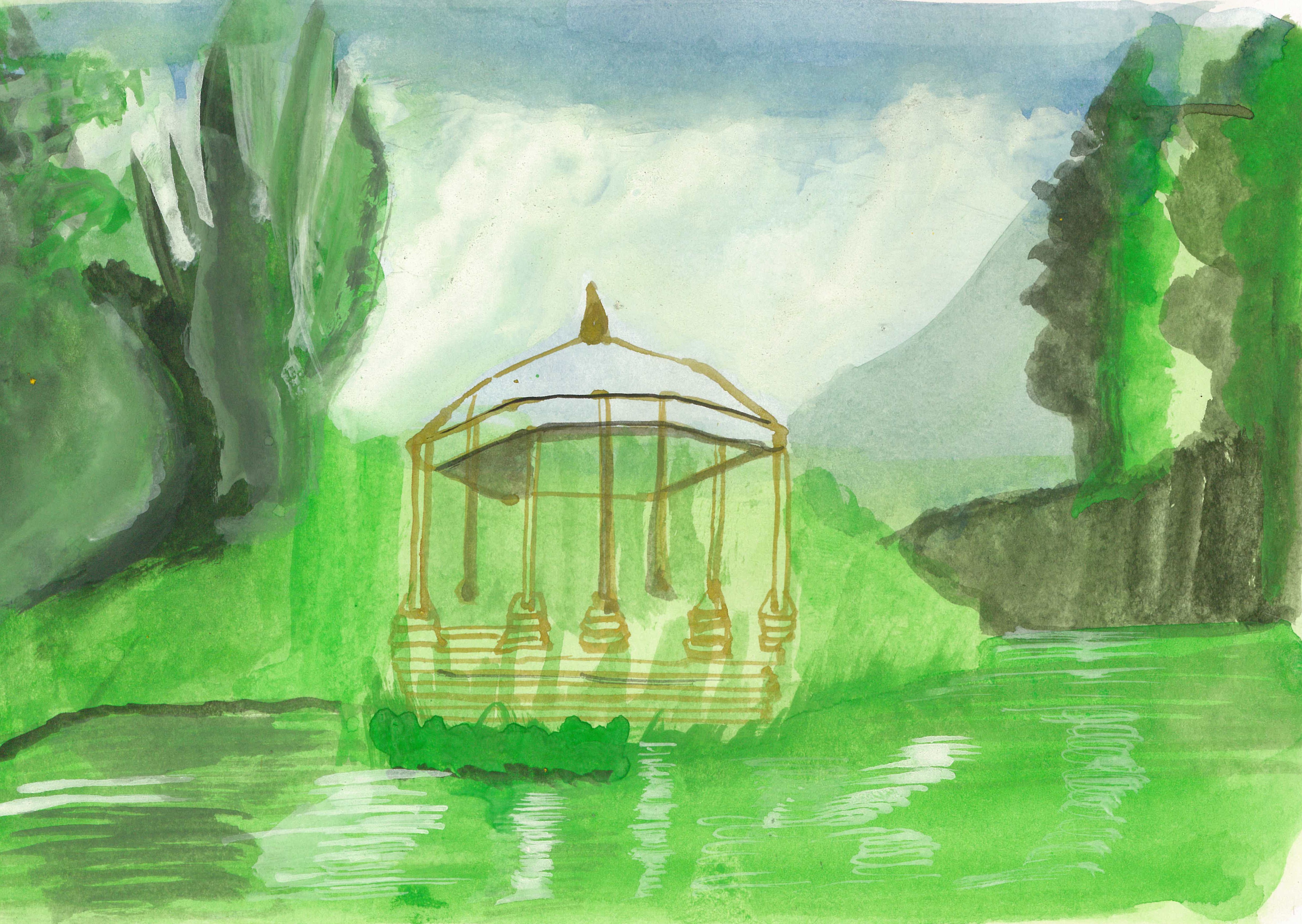
Location: The Kalidasa Memorial in Ramtek, Nagpur.
Point of Contact: An old-stone gazebo in the courtyard from where you can stare into the wild blue yonder, unencumbered.
Poets have presence. Certainly in the work they create. And inexplicably sometimes, they forever remain in the places they once sought inspiration from. When you find them, you find a passage into their beautiful, ingenious minds. This is their legacy, coming to life, in vivid detail, whenever their words are recalled.
Walking past the kernel of this memorial – a circular construction that’s probably the merger  of a minaret, a gazebo and a temple – I reflected upon murals of the Mahakavi’s work adorning its walls. He gave us words that breathe and burn – literary sensations that the world has been obsessed with. A mammoth white cotton ball lingers far above me in an otherwise fairly lit sky and I know just which one of his works I’ll be ruminating on. There’s a gazebo with the perfect view of this giant, fluffy, singular fog. Looking up, I fall gently back onto one of its pillars, sinking down into a cold marble floor. It has such a long journey to make, with such heavy purpose.
[freemium]Much has been said, even more written, about Kalidasa’s Meghadootam. But I’m here, in the place he wrote it, staring up at a cloud like he once did, perhaps feeling the very rush of emotions that prompted him to create this literary gem and all of a sudden, I want this cloud to carry a message to my love, my life separated from me.
I imagine the lovelorn yaksha, cursed by God Kubera to endure a hard year in exile as a punishment for failing in his duty. Wouldn’t he long to send word to his beloved wife? Word of his undying love for her? Word of the puncturing pain he suffers over their parting? And then one day, when the better part of the year had gone by, the mere sight of a cloud stirs his heart. He implores it to act as his messenger, entrusting it with all the passion in the marrow of his being. The message, as moving and resonant today as it was all those centuries ago. And even though the message is from the yaksha, it is the cloud who is the custodian of his true meaning. Nature’s lofty water-bearer: the real protagonist of the story.
The cloud is the one who truly lives the long journey from Ramagiri in the south to Alaka in the Himalayas, where the yaksha’s wife waits, weary and worn, consumed by thoughts of her husband. Meghadootam is filled with lush imagery – from the splendour of the bountiful earth to the magnificence of the gods, from the hypnotic lilt of birdsong, the many hues of blossoms, the rushes of rivers to the sultry lovemaking of courtesans, the cloud goes all along imbibing the beauty and wonder of the landscape, the people, the flora and the fauna.
This poem, in every sense, is an ode to the geography of India. Kalidasa describes his motherland as an easily accessible paradise. And might I say, at the cost of sounding regretful, indeed it was. Despite a plethora of mythical elements, the yaksha maps out a very topographically true journey for his friend and aide, the cloud. Much of the terrain described is real, and many of the sacred shrines and holy rivers can still be visited today, where ancient echoes continue to be heard, seen and felt.
I sense Sita and Rama, residing here, one of their shelters in exile. The Mountain belongs to Rama; its waters, Sita. The divine couple is invoked at the very beginning for the obvious thematic reminiscence of love in separation and the notion of a messenger carrying tidings between distant lovers. If the loyal Hanuman does so in the Adi-Kavi (The First Poet) Valmiki’s endowment to the world, the Maha-Kavi (The Great Poet) Kalidasa pays homage to the former by making the cloud take on the same role in his first poem.
I’ve read somewhere that no groundbreaking work of art or science emerges from a vacuum, and Kalidasa’s lasting innovations in literature reflect both his creative genius and his reverence for tradition. This dynamic between originality and conformity is neither strained nor irreconcilable. In the mind of a truly imaginative poet, these seemingly oppositional forces harmoniously coalesce to generate something new, and something that endures because it is born from within the tradition. And even when innovations are regarded as radical or revolutionary, in the hands of an iconic poet like Kalidasa, tradition is not defied, it is redefined.
I spoke “to the cloud with soft and solemn words that said welcome.” I may seem impulsive to the world but I do believe this cloud – but “a being made of mist, light, water and air-not a man with the fine senses and faculties needed to carry the heart of my message – will gladly do this for me out of friendship, or may be out of compassion for it can feel my pain.”
“Gentle cloud, are you truly committed to helping me, your friend in need?
Ah, even when you give me no reply, I understand the meaning of your silence.
When thirsty chatakas cry out for rainwater, you offer it to them silently,
For among the noble, the quiet fulfilment of a request is answer enough.”
 Sitting here, in an ashram on Rama’s Mountain, I want to know if my love is well. I yearn to touch her face. I hope to whisper in her ear all that should’ve been said before. Although I am beyond her reach, unable to be seen, too far off to be heard, I wish to speak through a friend kind enough to carry my heartfelt words to her. “For in times of separation, the quickly sinking hearts of lovers, like drooping flowers, are held up solely by threads of hope.”
A poet hits the target when, upon reading his words, you feel the way he does. Through Meghadootam, we become desperate to caress the neck of our distant dearest. You experience an intimacy even in the face of a separation. As paradoxical as that is, it is also symptomatic of Kalidasa possibly being the yaksha himself for he evokes that intensity of sensation.
Both their bodies, frail and fragile, burn with an inner fire. Shakespeare wrote it in Romeo and Juliet. Here’s what love is: a smoke made out of lovers’ sighs. When the smoke clears, love is a fire burning in your lover’s eyes. We’re “wet with tears and sighs of sorrow, and filled with lust and longing.” But I want her to know that I’m worse off than she is, being so far away, my way being barred by fate, and so, I endeavor to enter her heart through my imagination.
This bearer of water will go to my wife, bearing my message safe in his heart. And her heart, soothed and certain of her husband’s imminent return, will breathe new hope, blurring “the fine line between nature and humanity for those struck by love.” And she will listen with rapt attention to what the noble cloud says, “For when a true friend carries tidings from a husband to his wife, it’s almost as if they were united.”
Destiny, Kalidasa writes, is a wicked thing. It hasn’t favoured the wronged, wounded and aggrieved yaksha. Grief, I’ve learned, is really just love. It’s all the love you want to give but cannot. All of that unspent love gathers up in the corners of your eyes, the lump in your throat, and in that hollow part of your chest. Grief is just love with no place to go.
“When woodland spirits who dwell here see me throwing my arms into empty space,
Searching somehow for your perfect embrace,
Like the one I hold as a vision from my dreams,
They shed tears the size of pearls that fall without fail on to soft leaves of green.”
But a great poet named Rumi had once said that where there is ruin, there is hope for a treasure. The wind that comes from the north would’ve touched her. And so, I breathe in all I can.
“A gale wind blows from the Snowy Mountains,
Cracking open the spiral seed-cones of Himalayan cedars oozing with sticky sap, milky white and fragrant.
And then, my true one, as the wind drifts south,
I run to embrace it,
Believing that it caressed your body before coming to me.”
Perhaps, one day, when it is all finished, we will discover that it was never random. Even this wide, forced, brutal distance has purpose. Our love will not fade. “Our affections, intensified by our desire for each other, are stored away in a reservoir of love.” Only to burgeon with time away from one another.
‘When Lord Vishnu who wields the Saranga Bow rises up from his serpent bed,
My curse shall end.
So close your eyes and let these four months pass quickly,
And soon the two of us will bathe in the pure moonlight of an autumn night,
Fulfilling the wishes of our hearts that grew more intense while we were apart.”
Through the cloud, the yaksha, separated from his wife, finds a place for his love to go; for his grief to narrow.
Loneliness makes you question life. Its twists and turns: a wilderness and faith: your only compass.
“Reflecting deep within myself, I sustain myself on my soul alone,
And so you too, my blessed love, should never fear, nor lose faith,
For life is never eternal bliss, nor endless pain,
Our fortunes are forever turning, up and down and round again,
Like a chariot’s wheel.”
 Sometimes the questions are naïve, “Can the long hours of the night collapse into a single second? Can the pleasures of a mild summer day last all season?” My mind does entertain such impossibilities, without solace, as I burn and ache over our disunion. And one can sympathize, even be moved to tears, for it comes naturally to those whose hearts are soaked in compassion.
At other times, the questions are pretty grave, “Shouldn’t the fortunes of the wealthy alleviate the pains of the poor? Don’t those who set out on futile ventures end up as targets of others’ disdain?” For more than a mere moment, this cloud has become my principal source of strength – all-powerful, able and the almighty even. Like Helen Keller said, although the world is full of suffering, it is also full of the overcoming of it. A cloud, with its virtues, could help the world overcome its struggles; it could help alleviate my pain. This is not a futile venture and when the cloud brings back word of the welfare of my wife and a message of our shared memories, after delivering mine, nourishing the world, one step at a time, this herculean effort, this noble odyssey, will all be worth it.
India has never been more beautiful than in Meghadootam. And neither has love. In separation or union.
[/freemium]
DISCLAIMER: The content on this website is merely an opinion and not intended to malign any religion, ethnic group, organisation, company or individual. Nothing contained herein shall to any extent substitute for the independent investigations and sound judgment of the reader. While we have made every attempt to ensure the accuracy and completeness of the content contained herein, no warranty or guarantee, express or implied, is given with respect to the same. The SHOUT! Network is neither liable nor responsible to any person or entity for any errors or omissions, or for any offense caused from such content.
In addition to the above, thoughts and opinions change from time to time… we consider this a necessary consequence of having an open mind. This website is intended to provide a semi-permanent point in time snapshot and manifestation of the various topics running around our brains, and as such any thoughts and opinions expressed within out-of-date posts may not be the same, or even similar, to those we may hold today.
Feel free to challenge us, disagree with us, or tell us we’re completely nuts in the comments section of each piece. The SHOUT! Network reserves the right to delete any comment for any reason whatsoever (abusive, profane, rude, or anonymous comments) – but do SHOUT! with us, if you will.